

Copycat recipes annoy me sometimes.
Whole wheat flour adds fiber and flavor.
It surely does, but Panera’s Tomato Basil Bread isn’t a whole wheat bread.
I tried a number of different recipes before finding a version that passes muster for the kiddo.
I have a firsthand appreciation for wanting to please young palates. Yet if your goal is a copycat recipe, then their taste buds aren’t your ultimate metric.
The tomato powder is optional…
How can the only source of tomato flavor in tomato basil bread be optional?!
I also saw some surprising add-ins such as fresh basil, red chili flakes, and pesto. Panera clearly uses dried basil with no heat, cheese, or olive oil in their recipe. There’s even a “ copycat recipe” for this bread that looks more like a glazed cranberry pound cake!
Please note, with respect to you, I’m honest; with respect to my fellow food bloggers, I’m discreet. I will not link the sources of my harsh critiques.
That said, not all modifications are damnable. Many commercial bakeries use ingredients and techniques that are neither available nor practical for a home cook to obtain or execute. These must be substituted and adjusted.
Additionally, dietary restrictions may demand changes. I have no problem with a Gluten-Free Copycat Panera Tomato Basil Bread for example! But adding various flours for the sake of preference negates the “copycat” description in a recipe developer’s objective. Call it Panera(or whatever)-inspired!
Before I even started looking at other recipes, I bought a loaf of Tomato Basil Bread from my local Panera and studied it. And before even opening the bag, I weighed it!
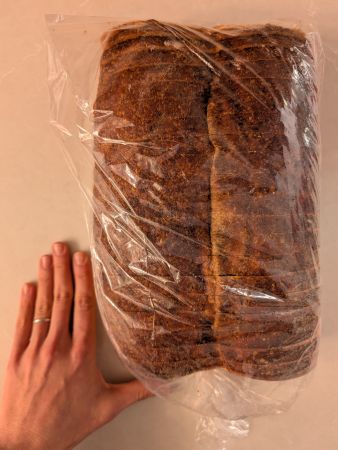
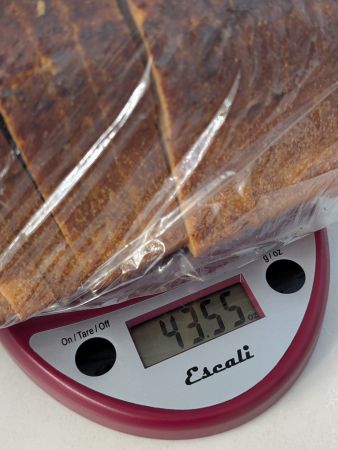
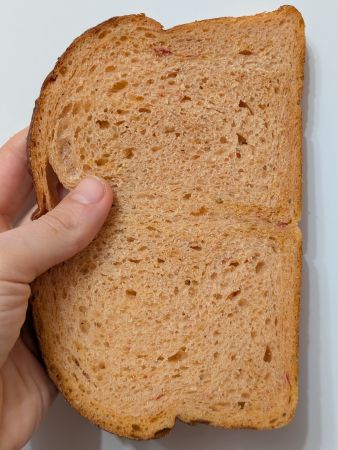
This substantial loaf is nearly 3 lbs (1.4 kg). It boasts a patchy brown, streusel-like topping over two humps of crust protecting a tight yet springy crumb. Once cut, a slice reveals two bright orange spirals uniformly speckled with dried tomato and basil pieces.
The recipes I referenced needed, at minimum, to match that bright orange color. Foremost, I wanted to find the correct ratio of flour:tomato product(s) because the ingredients list on the Panera at Home product wouldn’t tell me enough.
Though the Panera at Home products aren’t identical to their bakery analogs, they’re close enough to offer hints. The Tomato Basil bread bag lists the following ingredients…
…plus less than 2% of:
Those ingredients with an asterisk either could not, or could not practically, be included in a homemade vegan version and thereby demanded some attention.
Though it of course lists the quantity of protein per serving, no Nutrition Facts label even hints at how much protein comes from where. Some comes from all-purpose (wheat) flour; some, vital wheat gluten (wheat flour protein isolate).
Most likely, the blend of flour and gluten in Panera’s Tomato Basil Breads approximates the protein content of bread flour. A reasonable guess is that Panera keeps all-purpose - or even cake, or 00 - flour on hand and adjusts its protein content accordingly (less for pastries; more for breads).
I might suggest a similar system if I ran a bakery. Barring that, bread flour for bread makes the most sense.
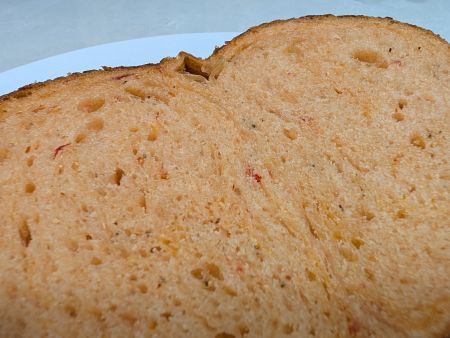
I was a little confused seeing tomatoes so high on the ingredients list (which is ordered by weight). Perhaps Panera sun-dries their own tomatoes? Visually, there just aren’t so many in the dough that they should be second! They’re also definitely sun-dried.
I almost ran my recipe trials with tomato juice. Then, I realized tomato juice widely varies in sodium content; tomato paste, not so much. My recipe therefore includes tomato paste and water to ensure consistent results across brands.
And most likely, the tomato paste you use takes care of the ascorbic acid on the list.
I love the culture (no pun intended) of sourdough: neighbors sharing starters they’ve been feeding for weeks, people near and far baking breads together and giving them as gifts.
But maybe you don’t have such a neighbor. Besides, even when I made a concerted effort, I could not taste much sourdough in Panera’s Tomato Basil Bread!
It must be there; it’s written in the ingredients list, and thus legally binding. I opted for an overnight rise which allows your dough to ferment and develop more complex flavors without being a true sourdough.
On an ingredients list, salt could be sea salt -
or table salt, pink salt, black salt, mine salt, smoked salt…
You get the idea. I simply used my go-to, Diamond Crystal Kosher Salt.
Though not impossible to find, calcium sulfate probably isn’t on the shelves of your grocery store. You might even have some if you regularly coagulate soy milk for tofu, brew beer, or make cheese.
Yet chances are you don’t. Since I’m already asking you to wait overnight, asking you to order a less-than-2%-of ingredient seemed unfair. I omitted it.
Natural flavor and lecithin are addressed in the next section.
By using Country Crock Homestyle Dairy Free Butter, I tackled palm oil, natural flavor, and lecithin. If you can’t find this product, you have options:
Do I know which undefined natural flavors are in Panera’s product? I can’t. They could be buttery -
or flowery, grassy, earthy, herby, hoity, toity…
Buttery is as good a guess as any. And that’s assuming my “butter” has buttery natural flavors!
There are plenty of arguments regarding why and which honey is good for us, our pollinators, and our planet. However, the bottom line is: Honey isn’t vegan, and this is a vegan food blog. I use agave nectar, but almost any light-colored liquid sweetened will work too.
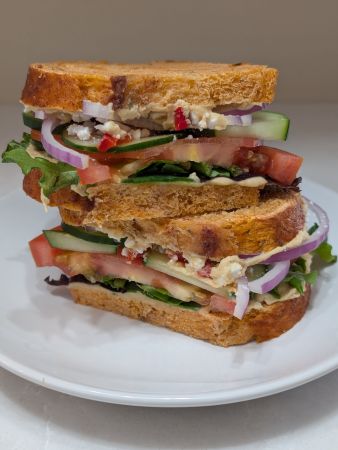
Logically, after several successful trials, I had to make Panera's Mediterranean Veggie Sandwich.
Be sure to alot time for Step 8!
makes one large loaf in a 2 ½-qt/L casserole
Bring any chilled ingredients (except yeast, if refrigerated) to room temperature.
Gather equipment, vessels, utensils, and other supplies:
In one of the prep bowls, whisk together Sugar Blend. Set aside.
Coat inside one of the lg bowls with about 1 tsp (5 mL/g) oil. In other lg bowl, whisk together dry ingredients.
Place sun-dried tomatoes and garlic (if using whole cloves) in food processor. Process 30-60 sec, until finely minced. Add remaining wet ingredients and pulse until combined.
Scrape wet into dry with spatula. Using lg mixing spoon, stir until dough starts coming together. Transfer onto counter.
With hands, gather and pinch ingredients into a shaggy ball. Vigorously push and pull left and right about 8-10 min, until smooth.
Rest dough in oiled bowl. Loosely cover and refrigerate at least 3 hrs or overnight.
Use another 1 tsp (5 mL/g) oil to grease casserole, then line bottom and sides with parchment.
Uncover and tear dough in half. Press and stretch one half into a rough rectangle slightly shorter than length of casserole. Roll long edge to long edge, then position in casserole seam side-down one side of center. Repeat with other half, other side.
Lay kitchen towel or plastic wrap over loaf. Leave to proof 1 ½ to 2 hrs.
About 1 hr into proofing, preheat oven to 400°F/205°C.
Meanwhile, whisk together glaze.
Uncover and liberally brush loaf with all the glaze. Place in oven, then immediately reduce temperature to 350°F/180°C. Bake 1 hr 15 min, or until an instant thermometer inserted into center reads 200-205°F/93-96°C.
Cool loaf in casserole 10 min, then transfer onto a wire rack. Allow to cool about 4 hrs, until room temperature, before slicing and enjoying.
Loosely wrap in a kitchen towel to store at room temperature for 2-3 days. If refrigerating or freezing, double-wrap tightly in plastic wrap and again in foil. Bread will stay fresh about 5 days in the refrigerator; 1 month, freezer.

Kale yes, I'm soy excited you're here! My name is Christi, and sharing food brings me even more happiness than puns.
Does It Vegan? is a question for conventional recipes as well as an answer for my career. Because no matter what else I've been, I've been a plant-based cook who thrives on connecting with people through their favorite foods.
Gratitude is the most scrumptious seasoning!
Thank You ♥
From the Bottom of My Hearth, Christi of Does It Vegan?


