

The most important thing I learned from reviewing vegan crème anglaise recipes is that fundamentally easy formulae can be exceedingly difficult to find. Thickening sweetened soy milk is not classified as advanced! Yet consistently thickening sweetened dairy-free milks into luscious custards with rich vanilla flavor requires more attention to detail than one may feel is necessary to give.
I gave that attention. Building off the best technique, flavor, and texture from other bloggers, I developed a vegan crème anglaise recipe that's not only reliable, but also adjustable for a range of applications and dietary needs.
“Crème anglaise sans oeufs {vegan}” by Laurianne Pao of Perle en Sucre
Pao’s undeniable targets for thickening her mixture melt any anxiety that comes from not knowing when to remove it from heat. This traditional method of using cornstarch – In short, boil for one minute. – is worth adopting not only for accessibility, but also consistent results.
“Vegan Crème Anglaise” by Thomas Pagot of full of plants
Pagot convinced me to use vanilla beans. I made an economic change to vanilla bean paste with an invitation to use pure vanilla extract instead. After all, whole vanilla beans are costly, and “budget” store brand ones tend to be brittle.
“Vegan Custard” by Melanie McDonald of A Virtual Vegan
McDonald proves that “butter” is necessary to replicate the mouthfeel of conventional, egg-thickened crème anglaise.
Perhaps I should’ve trusted a British blogger from the start! (Despite its French moniker, “crème anglaise” means “English custard”.) A little more vanilla and a little less cornstarch, in combination with Pao’s technique, essentially turns her recipe into my ideal formula.
Many questions remained.
The smallest cornstarch:"milk" ratio I encountered during my recipe review is 2% from Pao; highest, 12.5%, McDonald. Using 2 cups (480 mL/g) "milk", I decided to test both extremes starting with 1 Tbsp (15 mL/10 g) cornstarch and ending with 6 Tbsp (90 mL/60 g).
But the technique I'd adopted from Pao unlocked more of cornstarch's thickening powers. At 4 Tbsp (60 mL/40 g) cornstarch, my recipe became too thick to add any more.
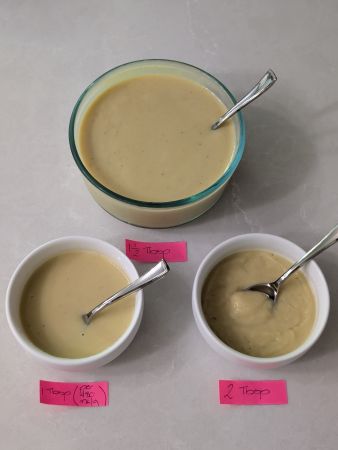
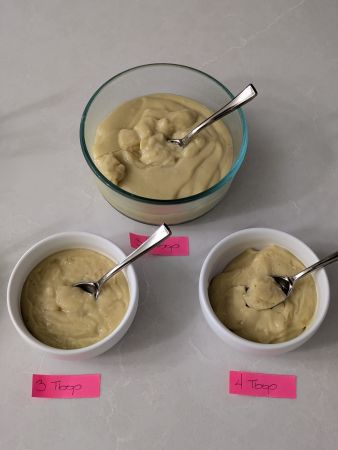
The answer to that question lies in another: What are you making?
Previously, for vegan crème anglaise, I'd bemoaned cornstarch:"milk" ratios less than 3%. Now, I'm recommending 2.5%!?
yes. The technique I adopted from Pao increases cornstarch's effectiveness so much, it practically eliminated the need to increase the amount of cornstarch for "crème" anglaise. (Thicker applications such as pudding and pastry "cream", of course, need more.)
While some bloggers specify a kind of dairy-free milk (Pao, unsweetened vanilla soy milk; Pagot, unsweetened almond milk), many do not. Hence, I had more questions!
I had run all tests to this point with soy. It makes the smoothest "crème" anglaise! Yet if you need or want to avoid it, the following alternatives appear in order of preference.
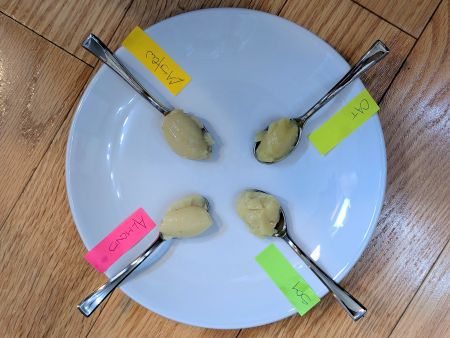
NOTE: Please read! This picture hardly suggests anything accurate regarding texture and flavor.
Although not the same, oat milk produces a vegan crème anglaise most similar to soy. It's slightly sweeter and less creamy, but comparable in both regards.
If I needed to cook this recipe for someone avoiding soy, I would make it with oat before any other dairy-free milk I tested.
The flavor of vegan crème anglaise with cashew milk astounded me! It's so caramelly, it can pass as flan with little to no tweaking.
Containing few macronutrients, however, cashew milk creates a more brittle product than soy and oat. It reminded me of Jell-O gelatin rather than any kind of pudding or cream.
I loved the notes of toasted nut that almond milk offered my vegan crème anglaise. They're delectable alongside vanilla!
Yet like cashew milk, almond milk also produces more brittle desserts. I would choose vegan crème anglaise with cashew over almond milk, though both are uniquely delightful in flavor.
Do not use pea milk in this application. I generally adore pea milk! Delivering an equal amount of protein as soy, I can usually rely on it to behave identically.
not here. While the thickness it produces is correct, the chalky texture pea milk imparts is uncomfortable at best.
I offer three variations ("crème" anglaise/pouring custard, custard/pudding, and "crème" patisserie/pastry "cream"), but the possibilities are endless!
Make vegan crème anglaise with 1 ½ Tbsp (22.5 mL/15 g) cornstarch, then add ¼-½ cup (60-120 mL/g) rum and freshly grated nutmeg for "egg"nog. Or, make it with 3 Tbsp (45 mL/30 g) cornstarch for a slightly looser pastry "cream" that's perfect for filling Vegan Boston Cream Pie.
yields about 2 cups (500 mL/g)
Determine cornstarch amount.
In a sm or med saucepan, whisk cornstarch, sugar, salt, and turmeric.
Whisk in ¼ cup (60 mL/g) "milk" 1 Tbsp (15 mL/g) at a time whisking until smooth before each addition. Whisking steadily, slowly pour in remaining "milk".
Set pan over med-hi heat, then bring to a boil while whisking constantly. Once bubbling, reduce heat to med and whisk vigorously for 1 min.
Remove from heat. Stir in "butter" and vanilla until "butter" is melted.
Pass through a fine mesh strainer into a serving pitcher or airtight containing. Use, or allow to cool 1-2 hrs, until room temperature, then refrigerate 2-4 hrs, until cold. Consume within 3-5 days.
All decisions in my vegan crème anglaise recipe may be explained by the above and additional posts. Two in particular, a recipe and a product review, informed this formula.
And if you can't find Country Crock Homestyle Dairy Free Butter, follow my reverse-engineered product recipe to make your own!

Kale yes, I'm soy excited you're here! My name is Christi, and sharing food brings me even more happiness than puns.
Does It Vegan? is a question for conventional recipes as well as an answer for my career. Because no matter what else I've been, I've been a plant-based cook who thrives on connecting with people through their favorite foods.
Gratitude is the most scrumptious seasoning!
Thank You ♥
From the Bottom of My Hearth, Christi of Does It Vegan?


